
Forest Lake City Directories: Confirmed Collections
The confirmed Forest Lake historical shelf is broader than a single printed city-directory run. The Washington County Historical Society, or WCHS, indexes a Forest Lake book and local cemetery sources, while its research center holds directories, telephone books, plats, newspapers, photographs, scrapbooks, deeds, and family or subject files. Minnesota Historical Society finding aids point to county registers, assessor rolls, court records, probate files, and township material. These sources can build a strong historical trail, but they should keep their own dates and collection labels.
| Collection or directory lead | Years or count located | Where held | Access and scope |
|---|---|---|---|
| Forest Lake book index | 1,931 name-index entries; publication year is not stated on the source page. | WCHS Forest Lake page and name index. | Online index lead; verify page and place with WCHS. |
| Scandinavian Cemetery index | 155 entries. | WCHS index. | Historical burial and name lead, not a current-resident list. |
| Small, lost, and abandoned cemeteries | 47 entries. | WCHS index. | Historical place and burial research; entries may be incomplete. |
| WCHS directory and telephone holdings | Collection is incomplete and organized by county. | Goodman Research Center. | Repository inquiry or research visit; no complete Forest Lake run was confirmed. |
| Minnesota Historical Society directory request | One person or business in up to five years, if volumes exist. | Minnesota Historical Society service. | Choose city directories, telephone books, or both for one city or town. |
The WCHS source list also describes a countywide index exceeding 180,000 names. The Forest Lake figures are source-entry counts, not population counts and not a roster of people living in Forest Lake. Keep that distinction in every citation.
Washington County Historical Society name-index sources show the collection categories behind the Forest Lake results.
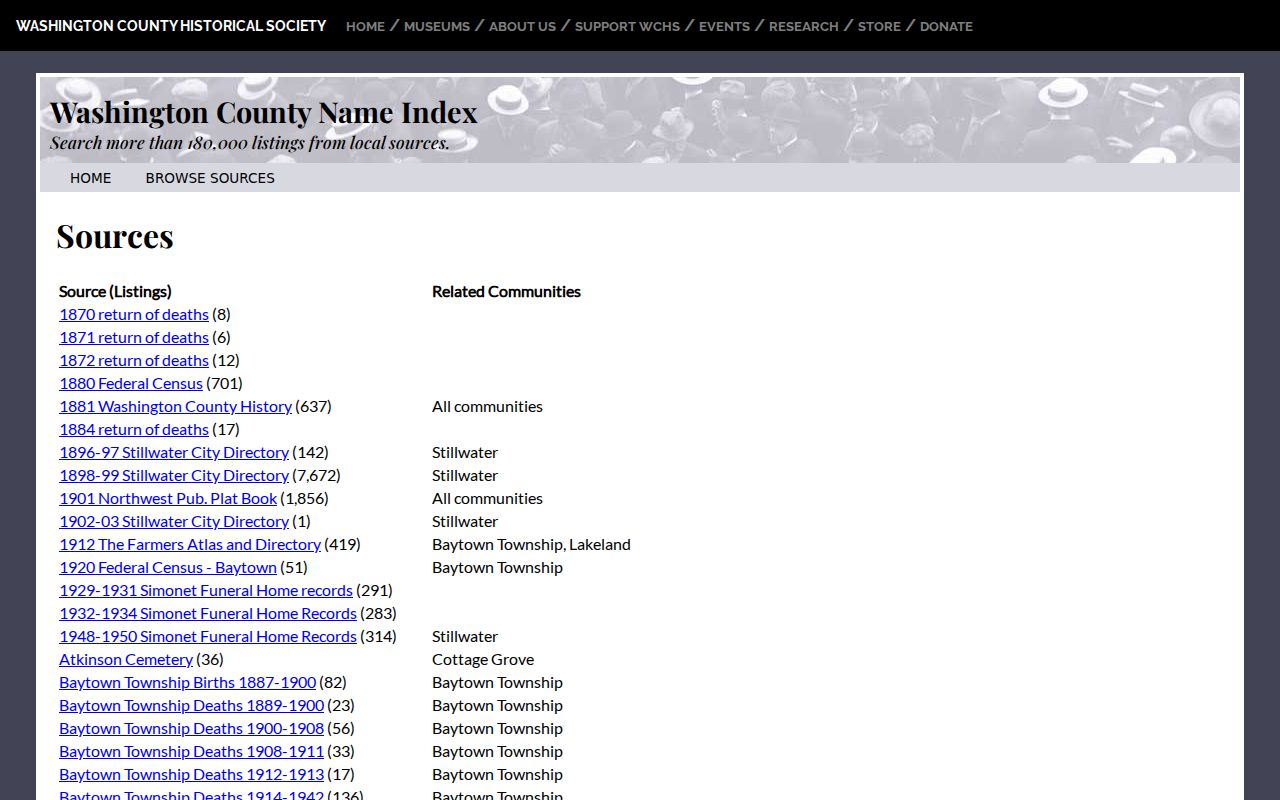
The index is a starting point for a source citation. An entry must still be checked against its original page, page date, and collection context.
Forest Lake City Directory Gap
No official source located a complete Forest Lake Polk city-directory run, a specific Forest Lake city-directory year, or a complete local reverse-directory set. That gap is useful information. It prevents a researcher from promising a volume that has not been documented. WCHS confirms incomplete telephone holdings, and libraries may have licensed databases or shelves that do not have a stable public inventory. Ask the reference desk about a particular year, surname or address-to-occupant need, and whether a scan or citation is available.
For a bounded request, the Minnesota Historical Society City Directory Search Request can search one person or business in up to five years of one place’s directory or telephone volumes. The order asks for a name, city or town, year or years, added identifying information, and a choice of directory volumes, telephone books, or both. The listed price is $10 for one type or $20 for both, including a nonrefundable $5 processing component. Usual timing is three to four weeks, with a possible wait of up to twelve weeks.
Minnesota Historical Society’s directory-search request shows the available request choices and the caution that a city or year may not be held.
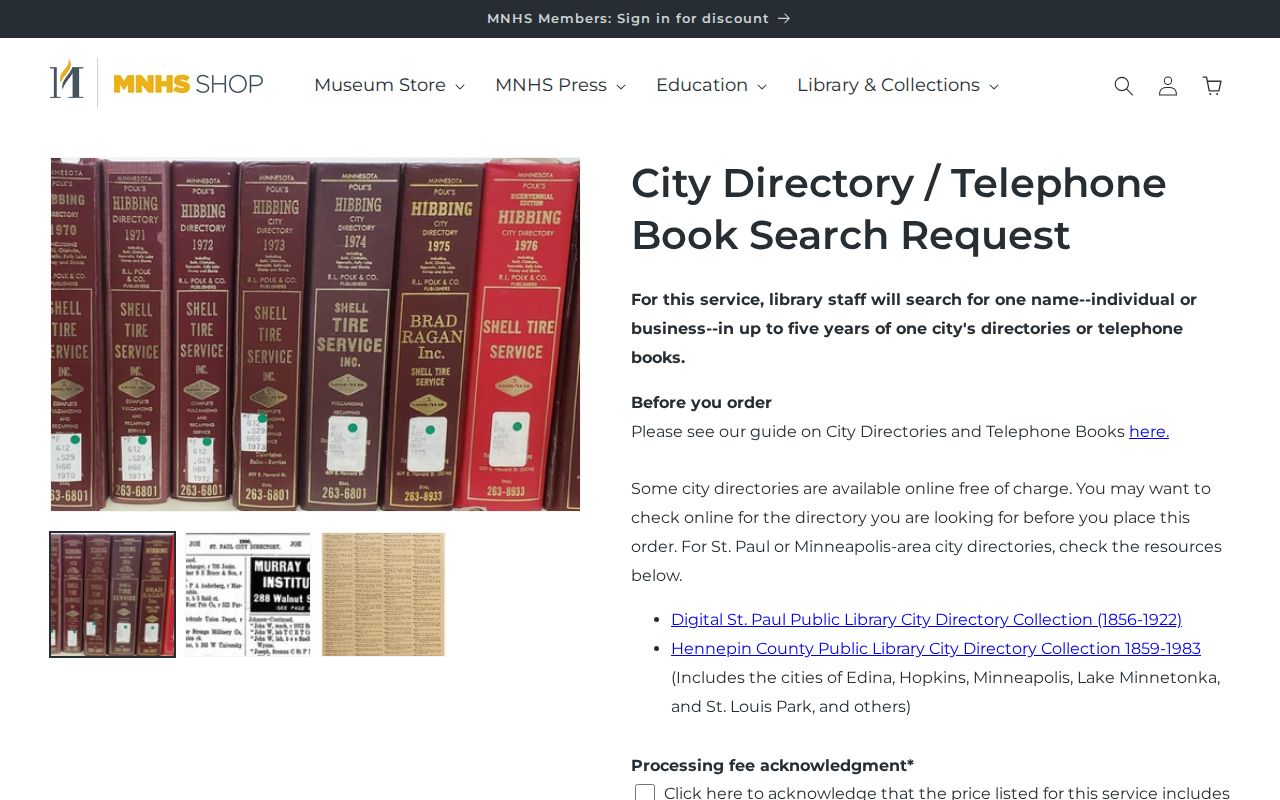
If the requested volume is absent, the service can provide the page where the name would have appeared when possible. That is useful documentation of a search attempt, not evidence that a person was absent from Forest Lake.
Note: A telephone book, a city directory, and a city staff list have different editorial purposes and should never be described as the same collection.
Reading Forest Lake Directory Results
No stable official scan of an actual Forest Lake directory entry or its abbreviation key was located. For that reason, a result should be transcribed exactly as it appears instead of being expanded into a guessed biography. Record the spelling, publication title, year, page, and whether it is a historical directory, telephone book, census, index card, or archive finding-aid result. An address can be a business, mailing, rural, or residence-related field depending on the publication.
| Name and spelling | Copy the surname, given name, initials, and any spouse notation exactly as printed. |
|---|---|
| Role or occupation | Transcribe only when the source prints it; do not infer a private residence from an employer or business entry. |
| Address field | Preserve the house number, street, rural route, or post-office wording and identify the source year. |
| Household notation | Record owner, renter, widow, boarder, or other notation only when the volume actually defines it. |
| Page and key | Save the page number and abbreviation key so another researcher can read the same shorthand. |
- Criss-cross directory
- An address-ordered section that can lead from a street or phone entry to a dated name where the volume provides one.
- Householder index
- An index organized around a named household contact rather than every person at the address.
- Abbreviation key
- The publisher’s explanation of shorthand, usually needed before interpreting a mark as a relationship or address type.
Minors are often not listed, and women may be listed independently only in some periods or circumstances. A missing name can mean the publication did not include that person, not that the person was absent from the community.
Forest Lake Historical Directory Indexes
WCHS gives Forest Lake research a set of local, named collections beyond a directory title. Its Forest Lake page links the 1881 Washington County History, the 1901 Northwest Publishing plat book, the Forest Lake book, Scrapbook Index, Poor Farm deaths and registry, cemeteries, World War material, biographical files, deeds, photos, and school scrapbook. Each is a different type of evidence. A cemetery entry may help establish a burial lead. A plat book can orient a historical parcel. A scrapbook can point to a date that needs independent confirmation.
Countywide index counts are useful only with their labels. WCHS lists 247 deed entries, 2,434 biographical-file entries, and 3,993 scrapbook entries, but those are not all Forest Lake entries. Historical names should be compared with the collection’s stated geography before drawing a Forest Lake conclusion.
WCHS research collections describe the local-history materials held at the Goodman Research Center.
The center’s mix of directory, map, newspaper, photograph, and subject-file material can turn an index lead into a dated, documented historical record.
Forest Lake Directory Research Desk
The Nancy & Robert Goodman Research Center and Warden’s Carriage House are at 602 N Main Street in Stillwater. WCHS lists research hours of noon to 5:00 on Tuesday, Friday, and Sunday, and 3:00 to 9:00 on Wednesday; appointments are available. Its listed contact is 651-439-5956 and information@wchsmn.org. A nonmember research visit is listed at $5, mail research at $25 an hour with the first hour paid in advance, and copies at 25 cents a page.
State archives are another access channel. The Minnesota Historical Society finding-aid index identifies Washington County records such as birth registers, marriage records, assessor rolls, election materials, court books, probate files, and Forest Lake Township records. A finding aid shows that a series exists and where to ask about it. It does not mean every item is digitized or open in the same way.
Minnesota Historical Society Washington County finding aids are the archival route for series-level coverage and access questions.
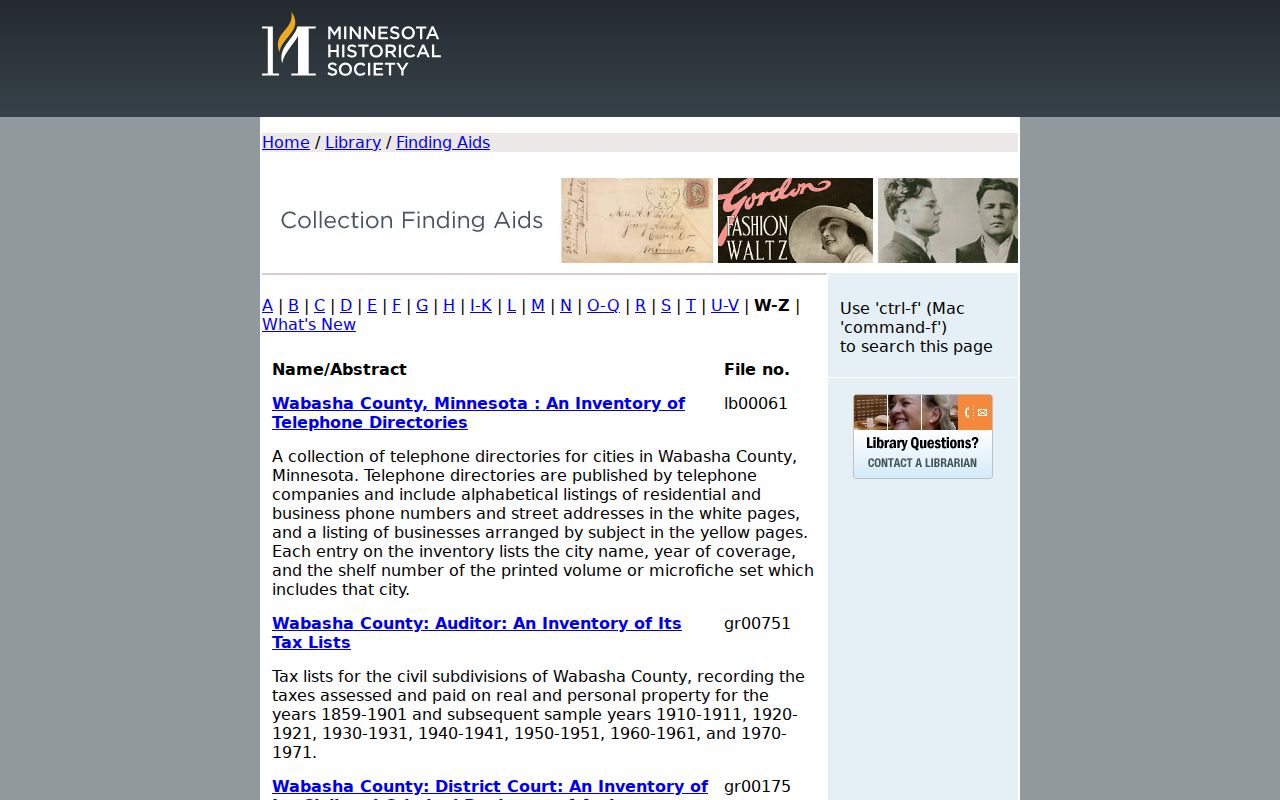
Bring name variants, an approximate date, the historical jurisdiction, and a record type. That request is more likely to reach the right box, roll, microfilm, or repository than a request for every record about a family.
Forest Lake Names Across Jurisdictions
Forest Lake historical records can carry several legitimate place labels. The area was part of Marine Township, the village was platted in 1868 and organized in 1893, it became a statutory city in 1974, and the city and township combined in 2001. The railroad’s 1869 completion and the growth of lake homes also shaped how local places were described. A person may appear under Forest Lake Township, Forest Lake Village, a city label, or Washington County without a move having occurred.
- 1868: the Forest Lake village was platted.
- 1869: railroad completion encouraged settlement through the area.
- 1893: the village was organized.
- 1974: Forest Lake became a statutory city.
- 2001: the city and township combined.
Use the City of Forest Lake history with the document’s own date and geographic wording. The timeline explains name variation; it does not convert an old township address into a modern street address without a second source.
Note: No authoritative Forest Lake street-renaming or street-renumbering chronology was located, so retain the original address wording in a historical citation.
Trace Forest Lake Directory Years
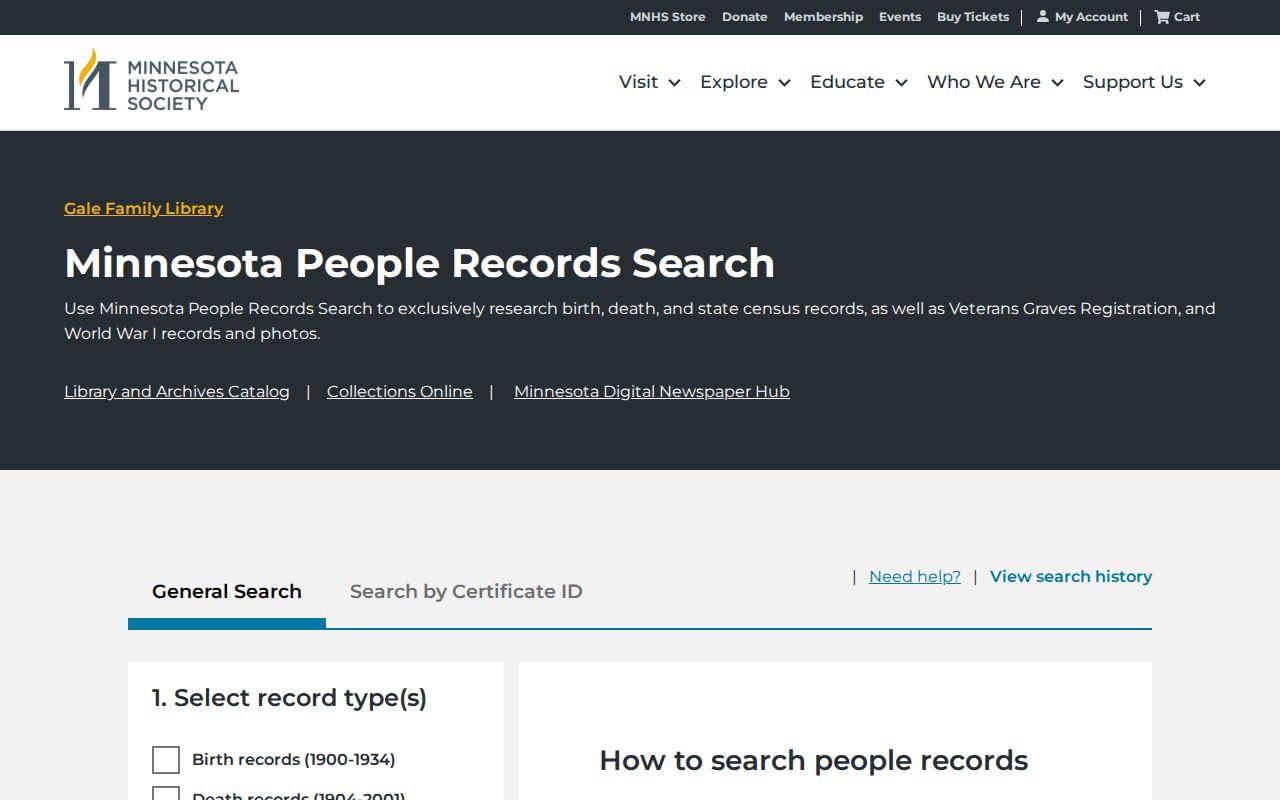
Family-history work is strongest when each source has a narrow job. A directory or telephone entry can provide a spelling, address, occupation, or household clue at one point in time. The Minnesota Historical Society’s People Records Search adds indexed birth, death, state census, veteran, and military-related collections. Federal census records provide household snapshots through 1950. Neither source is a complete current-resident record, and a county of death or an old address does not necessarily identify later residence.
- Start with the known name, year, and jurisdiction label. Search spelling variants and retain the exact form used by the source.
- Request or inspect the relevant directory or telephone-book year. Record every address, occupation, notation, page, and publication type.
- Compare a second date before claiming continuity. A changed address, absent entry, or different spelling needs a corroborating source.
- Pair the dated entry with the closest available Minnesota state census or federal census. Check the enumeration context if name OCR fails.
- Use deeds, probate, cemetery, or obituary material only as the next appropriate evidence type, and cite its date and custodian.
Minnesota Historical Society People Records Search supports name, location, date, and collection filters for several historical record types.
A historical directory absence is not proof of a departure, death, or name change. It may reflect the publication’s selection rules, a missing volume, or a source that was never intended to list every household.
Forest Lake Municipal Directory
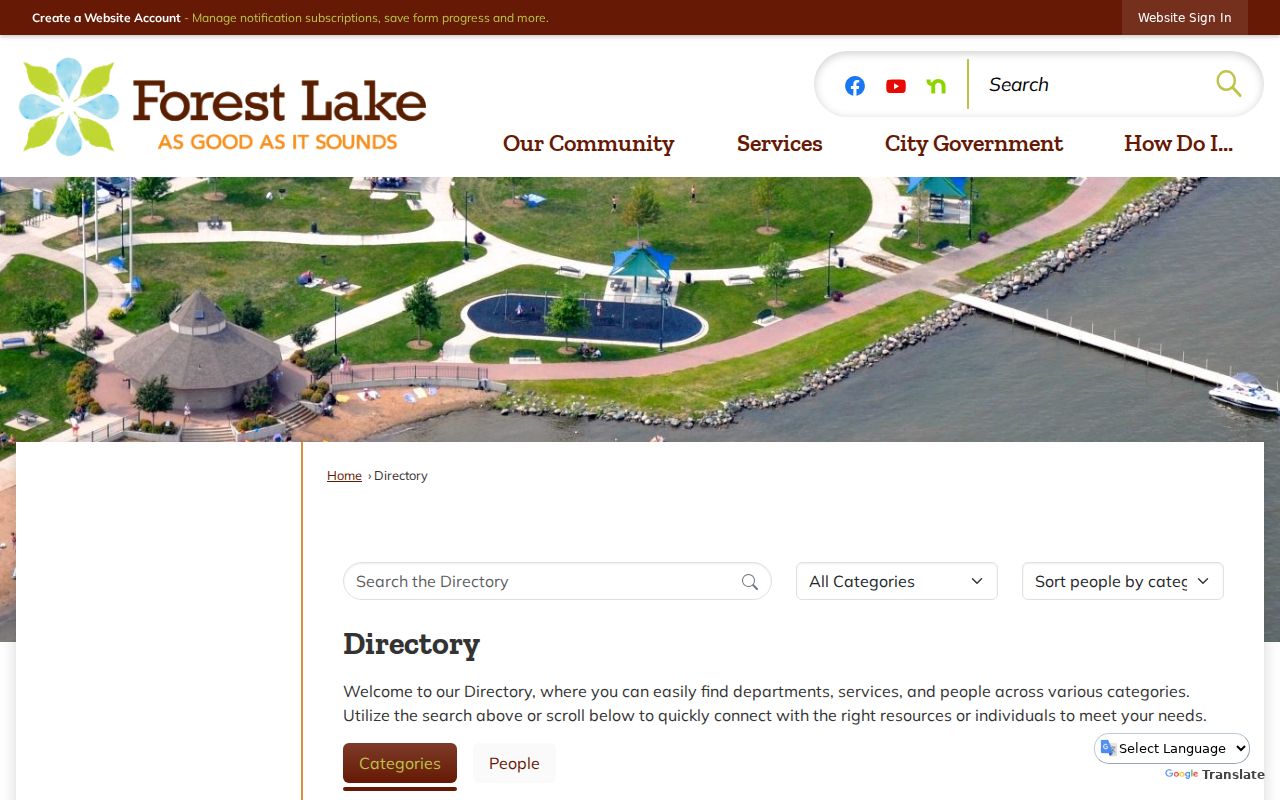
Forest Lake’s current municipal staff directory is useful for locating an office, not for reconstructing a historical household. Its filters include Category, First Name, Last Name, and Search. The categories cover bodies and departments such as the City Council, Planning Commission, Economic Development Authority, Building Department, Police, Parks, Public Works, Zoning, Finance, and Election Information. A staff listing can identify the records custodian or department contact for a permit, notice, or meeting record.
City Hall is at 1408 Lake Street S, Forest Lake, MN 55025, and the staff directory lists Monday through Friday hours of 8:00 a.m. to 4:30 p.m. The public directory may show official title, email, and department phone data. Those are work-contact fields. They should never be presented as proof that a city employee lives in Forest Lake.
Forest Lake’s municipal staff directory provides the category and name filters for city contacts.
For a city public-data request, name the body or record series, date range, and desired format. Forest Lake’s data-practices policy allows mail, fax, or electronic delivery where records are maintained in that form.
Limits of Forest Lake Directory Evidence
A Forest Lake historical-directory result is a dated observation, not a universal directory of residents. Such directories generally list heads of household, while minors may be absent and women may be listed differently depending on the period. An old address can be a business, mailing, rural, or residence-related address. A WCHS name-index match may be a book, cemetery, photograph, deed, school, or scrapbook reference. The collection type controls the meaning.
Disambiguate same-name results with the middle initial or spelling, date, role, historical jurisdiction, parcel or legal description where relevant, and a second source. The city staff directory has a separate role. Its public contacts are not a citywide resident directory. Safe at Home, confidential vital records, protected voter data, sealed court material, and restricted student records remain outside a historical directory search.
Source check. A dated directory, index, or archival finding aid can support genealogy and local-history research. Do not combine historical names and addresses into a current location profile or use them to harass anyone.
When a record is not found, report the collection searched, date range, and access condition. That is more reliable than turning a missing title or index hit into a conclusion about a person’s history.